

Social media listening guide: Tools & tips for success
In a world where every customer has a megaphone in their pocket (a smartphone), it can be difficult for brands to feel in control of their narrative.
Unlike customer surveys, which are often unanswered or biased, the internet is a valuable source of feedback, both good and bad. These comments are packed with insights into how customers feel about a particular brand or product.
Social listening is incredibly useful for shaping business strategy, earning customer loyalty, and managing brand reputation.
In this guide, we’ll walk through social listening best practices, social listening tools, and when to consider a third-party social listening service.
What is social media listening?
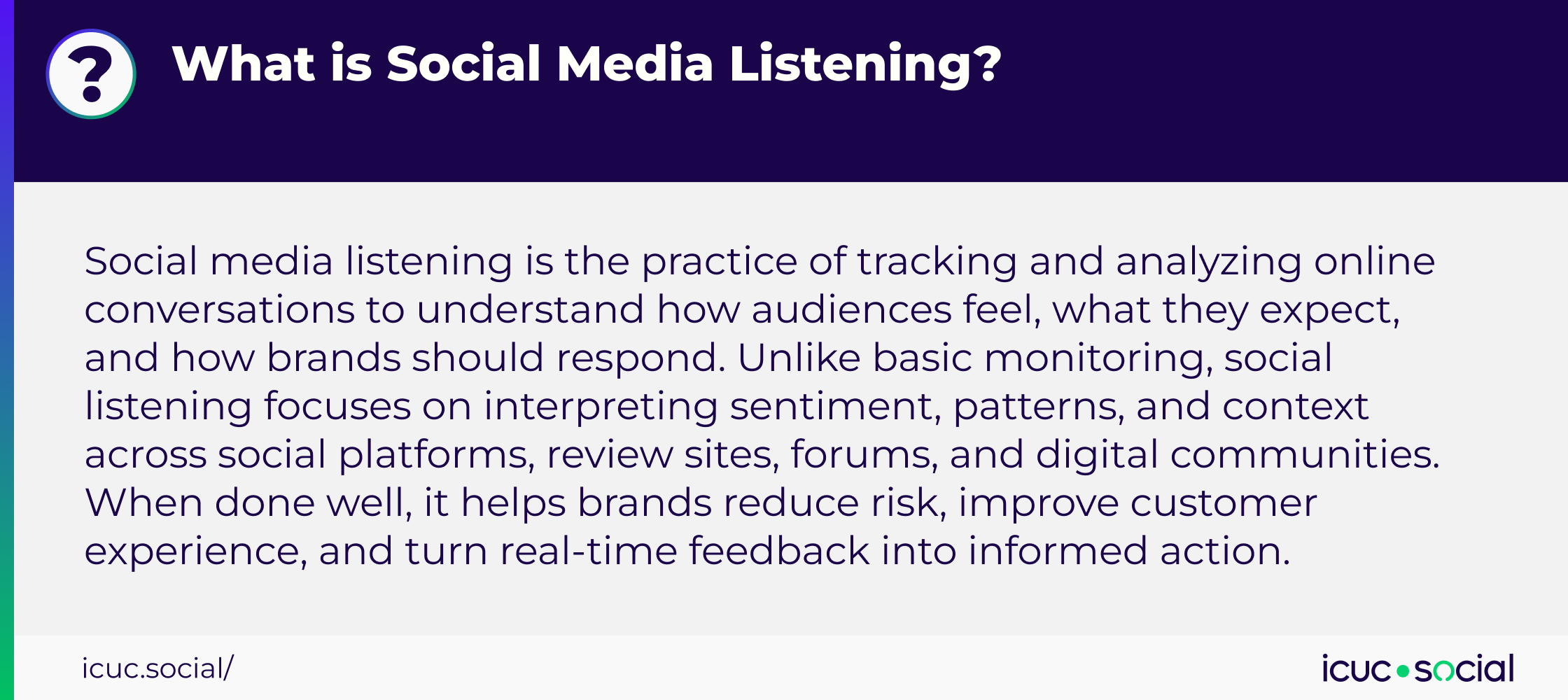
Social listening is the act of monitoring digital conversations on social media to understand what customers are saying about your brand, product/ service, and competitors.
For enterprise marketing teams, social listening is an integral part of a digital marketing strategy. It forms the foundation of any audience analysis and consumer insights strategy.
Social listening strategies enable brands to make critical business decisions without relying on assumptions or guesswork. They guide brands on where (and how) to show up for their customers, identify trends, and stay relevant.
What are the benefits of social media listening?
For enterprises, social listening can help:
Influencer marketing campaigns: Social listening helps brands pinpoint which creators are already known and trusted with their audience, avoiding potential partnership missteps.
Content campaigns: Social listening reveals which topics and formats are actually resonating with an audience.
User-generated content (UGC) marketing: Social listening captures how people naturally talk about a brand and what they choose to share.
Reputation management: Listening provides early indicators of sentiment shifts and emerging issues, enabling brands to respond before problems scale.
Crisis management: Social listening identifies crises early, before narratives have fully formed, and helps guide faster, more informed responses.
Improved customer experience: When brands pay attention to their customers, they can better understand the nuances behind their emotions, not just keywords. Social listening empowers customers to explain how they feel honestly and in their own words.
Transparent decision-making: Social listening can serve as a sort of crystal ball for brands. It allows them to pick up on early signals that indicate whether their product launch is likely to do well, for example.
Early risk awareness: By monitoring conversations in real time, brands can spot emerging issues, shifts in sentiment, or compliance risks early. This allows teams to respond before a crisis breaks out.
Stronger audience trust: Acknowledging feedback is the fastest way to build trust among your audience.
Improved campaign performance: When listening creates a feedback loop, brands can optimize messaging mid-campaign, double down on what resonates, and adjust quickly based on real audience response instead of waiting for post-campaign reports.
“Social media listening is more than searching for your brand name on a social media network. It means truly understanding how consumers feel about your brand and using this to guide future approaches.”
“When people want to be heard, they let you know about it in a comment, post, or review. This is a gift for the brands who choose to pay attention. Social media listening gives brands the ability to respond with context and empathy, not assumptions.”
What should brands track with social listening tools?
Social media listening involves monitoring all social media channels using AI detection and human moderation. This includes social media-adjacent channels like podcasting, review sites, blogs, and other digital communities.
For a comprehensive social listening strategy, brands configure social listening tools to track:
Brand conversations across channels: Where, how, and why do people talk about your brand across platforms and channels?
Overall sentiment: How do people feel about your brand, and is it getting better or worse?
Industry themes: Which topics and conversations are gaining traction across your company’s vertical?
Cultural shifts: What emerging behaviors, values, and moments could be influencing how your audiences think and act?
Competitor mentions: How are your competitors perceived, compared, and discussed across the internet?
Market dynamics: What changes in demand, expectations, and priorities are happening over time?
Topics and keywords of interest: What key language, phrases, and ideas do audiences use when discussing issues relevant to your brand?
How does social listening work?
In practice, social listening is done via AI-powered scraping and/or human review. Examples of channels that get scraped include:
Facebook
Instagram
Reddit
Discord
TikTok
Review sites (like TrustPilot, G2, and Capterra)
X
LinkedIn
YouTube
Online forums
App store reviews (such as the Apple App Store and Google Play)
Blogs and blog comments
Social listening strategies should flag risks and produce insights. These insights should be actionable, meaning they should include:
What’s changed?
Why does it matter?
What to do next?
For example, a social listening team notices a spike in negative sentiment tied to a specific product feature or policy. The action is to update their internal response guidelines and proactively involve the product or legal teams. This way, they can create messaging to help curb the issue before it spreads.
Another example could be around content and messaging. If a social listening team notices high engagement around a specific theme or customer pain point, they can share this information with sales and marketing.
These teams can then create sales enablement materials and advertising copy that address these specific topics to improve engagement.
You may have heard the terms social listening and social monitoring used interchangeably, but they’re not quite the same. Let’s look at the core difference between these two approaches.
Social listening vs. social monitoring
While social monitoring tracks online activity, social listening goes a step further to interpret its meaning.
For example, social monitoring would look at customer complaints and comments, and sometimes even respond to customers who make them.
With social listening, these comments and complaints are seen as a pattern to track over time. Instead of responding to customers and declaring the job done, social listening instead asks, “Why did this customer say this? Is it a part of a larger trend, and how should our strategy adapt?”
Let’s take a look at each of these approaches to social media moderation in closer detail.
Social listening
Social listening is the practice of tracking online conversations related to your brand or industry, with a focus on understanding the context, sentiment, and trends within these conversations.
Social monitoring
With social monitoring, teams can set up tools to track mentions of a brand, specific competitors, related keywords, or hashtags. This process may also include response workflows, but it primarily focuses on quantitative data collection. This data collection provides the foundation for comprehensive social listening.
Social listening vs. social monitoring comparison chart
Aspect | Social Monitoring | Social Listening |
Focus | Micro-level, specific mentions | Macro-level, broader conversations |
Approach | Reactive, immediate response | Proactive, long-term strategy |
Depth | Surface-level data collection | In-depth analysis and interpretation |
Timeframe | Short-term, real-time | Long-term brand analysis |
Purpose | Customer support, crisis management | Strategic insights, market understanding |
Automation | More automated, tool-dependent | More manual analysis required |
Outcomes | Tactical actions, quick responses | Strategic decisions, long-term planning |
Data Type | Quantitative (metrics, volume) | Qualitative (sentiment, context) |
Examples of social media listening
These customer examples show how social media listening translates online conversations into measurable business impact.
Expanded social listening and moderation with ICUC to capture customer conversations at scale.
Shockz captured a 10,000+ item increase in engagements, 50% faster response times, and measurable improvements in customer sentiment.
Used ICUC’s 24/7 social listening capabilities to identify brand mentions on TikTok.
One surfaced opportunity led to personalized outreach within 24 hours.
Applied ICUC’s social listening and review monitoring across 400+ franchise locations to surface guest issues early.
This drove response rates from 3% to 99%, improved average review scores from 2.2 to 4.0, and enabled action on around 20,000 customer reviews.
Leveraged ICUC’s real-time social listening and community engagement to amplify an organic brand conversation into a campaign moment.
The result was a 24.6× increase in Twitter impressions, 29.5× increase in Twitter engagements, and 31× increase in Instagram engagements month over month.
To achieve similar results for your brand, let’s discuss how to build an effective social listening strategy.
How to build an effective listening strategy
Developing an effective social listening strategy requires thoughtful planning and consistent execution. The following steps will guide you through creating a customized approach that aligns with your brand objectives and delivers meaningful insights.
1. Identify goals and priorities
To ensure your social listening strategy aligns with your broader objectives, define what you hope to achieve. This could be improved in brand protection, customer experience, content optimization, or risk prevention.
Prioritize the channels with the highest visibility, volume, or regulatory exposure, and establish clear ownership of insights so your findings drive decisions.
B2C and B2B listening will focus on different channels, but the goals will likely be the same.
2. Choose the right topics and signals
The more well-thought-out your themes are, the more meaningful your social listening will be.
Make a list of the things you’re most interested in tracking, whether it’s themes, sentiment shifts, or recurring issues. Then, you’ll be able to monitor language patterns and intent to separate noise from meaningful signals.
Note that your list of essential topics and signals should not be static. Treat this as a living, breathing list that will change as audience behavior and risks evolve.
3. Create a consistent reporting rhythm
Determine which issues should be considered urgent, and justify the need for a real-time alert with an immediate response.
You should also set up a cadence for monthly and quarterly reports that will provide in-depth trend analysis and planning.
Ideally, this should be a predictable rhythm, so your stakeholders can know when and how to act.
4. Turn insights into brand actions
Every insight should translate into a brand action. This is easiest when every insight has a clear owner and next steps. This way, your findings can inform adjustments to engagement guidelines, messaging, or escalation workflows.
This plan should also include sharing relevant insights with other teams, like product, customer experience, legal, or marketing. The right social listening tools and services can go a long way toward helping ensure you disseminate your findings across teams.
“Brands don’t fail because they lack data. They fail because they don’t act on what their audience is already telling them. Social media listening closes that gap.”
“For a long time, brands treated social media as a broadcast channel. There is no doubt that today, the channel works both ways. The brands who do the best at social media are the ones that allow their customers to talk back. It’s not noise, it’s a cutting-edge advantage.”
Social listening tools & services
Social listening tools themselves come in different forms, including:
Conversation capture and monitoring tools that track keywords and hashtags.
Sentiment and trend analysis tools that specialize in pattern recognition.
Platforms that solely focus on brand protection.
Within these tools, services may also vary by brand focus.
For B2B brands, this could look like LinkedIn social listening.
For direct-to-consumer (DTC) brands, this could look very different and may include Facebook social listening.
Both of these verticals could benefit from TikTok social listening.
Once you have the right social media listening tools in place, you can create your plan. Learn more about social media listening best practices to develop a robust strategy.
Elevate your social listening with ICUC
Online conversations never end. For teams looking to get started with social listening:
Always start with a goal.
Determine which channels are essential for your brand.
Pinpoint who owns insights and reporting.
Track metrics.
Choose a partner.
ICUC’s social listening helps teams feel informed, confident, and ready to act on insights. We offer 24/7, multilingual support, as well as curated tools and human-guided analytics.
Our expert teams will help you track and sort through conversations about your brand, competitors, and industry, as well as monitor social media opportunities, sales leads, trends, and sentiment.
Book a meeting with us to learn more about how our 24/7 social listening team can help your brand harness the power of social media listening.
FAQ: Social media listening
Why does social media listening matter more than ever today?
The more time people spend online, the more critical it is to engage in social listening.
Anyone who has spent any time online knows that conversations are fast, the court of public opinion is scathing, and issues can spiral out of control.
Social listening helps brands detect risks early, understand audience expectations, and respond quickly with empathy.
How is social media listening different from traditional analytics?
Traditional analytics can successfully measure what happened, but social media listening explains why it did.
Social listening goes far beyond performance metrics to capture key factors such as sentiment, intent, emotion, and emerging narratives. This gives a full 360-degree view into human behavior.
What signals should brands track with social media listening?
This will differ between brands. But most can benefit from tracking sentiment trends, recurring themes, brand mentions, customer pain points, emerging shifts, and shifts in audience language. This provides brands with a broad safeguard against potential reputational and legal risks.
How do you know if your social media listening strategy is working?
Teams know their social media listening strategy is working when they can measure actions taken from insights and their impact.
These impacts may include faster issue detection, more transparent reporting, better-aligned responses, and measurable improvements in sentiment.
About the Author

Nicole van Zanten
As Chief Growth Officer at ICUC, Nicole leads global growth across marketing, client success, and business development. With over 15 years of leadership in social media, content strategy, and digital transformation, she brings a unique mix of creative vision and operational rigor to building high-performance teams and sustainable revenue growth.