


How to Create a Social Media Marketing Strategy
If your approach is reactive, you create fragmented messaging, diluted channel performance, and metrics that fail to tie to revenue. A defined social media strategy clarifies priorities, sets channel-level expectations, and ensures your content supports long-term business objectives. As your enterprise’s chief marketing officer, you should formalize a response framework for online communities that protects your reputation and ties social performance directly to revenue, retention, and customer experience metrics.
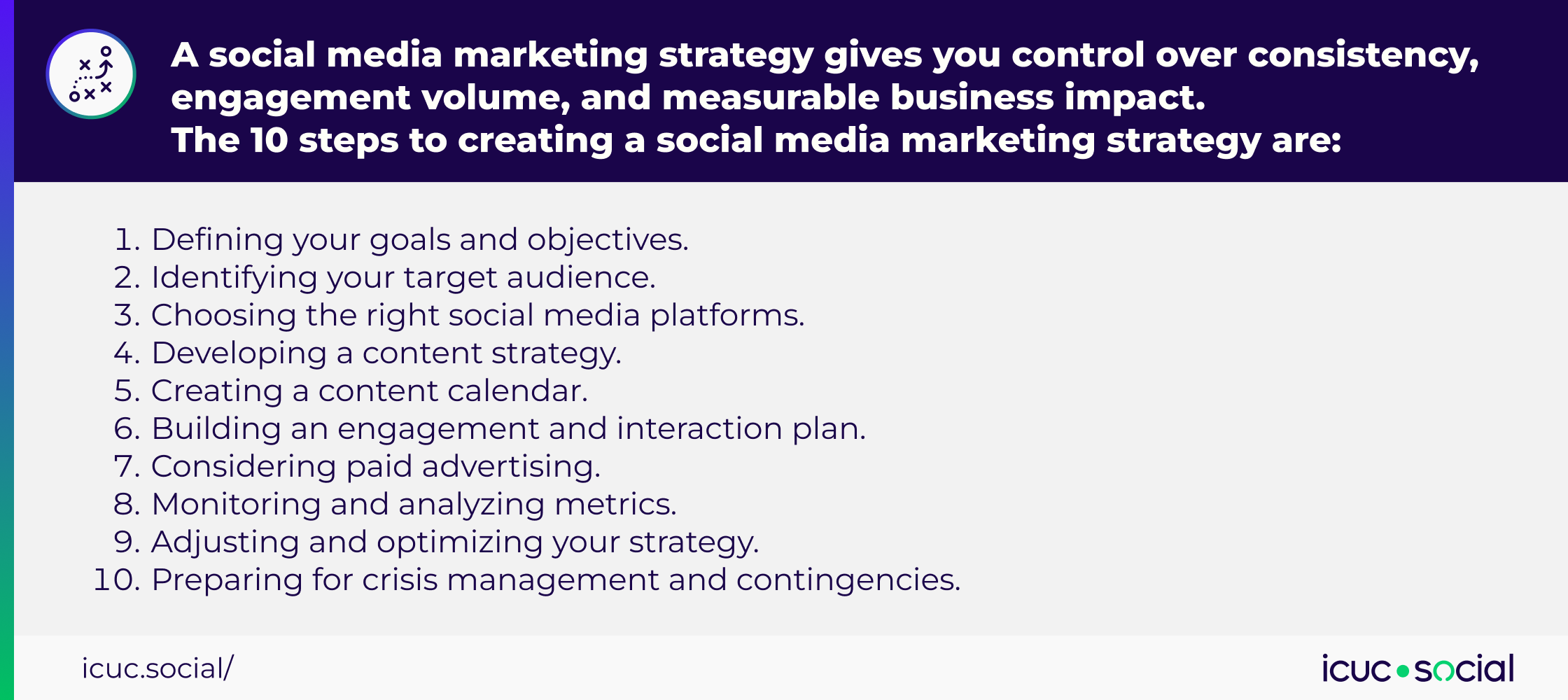
This guide outlines 10 steps to building a social media strategy that drives measurable results. You will learn how to approach alignment gaps and performance expectations, apply proven frameworks, and use ICUC’s social media strategy services to drive measurable growth. Use this social media strategy template to formalize your strategy and align your team around measurable priorities.
What is a social media strategy, and why is it important?
A social media strategy defines how your channels will contribute to awareness, pipeline, customer retention, and brand reputation. It outlines protocols for posting content, selecting platforms, tracking metrics, and engaging with your audience, as well as who is responsible and what tools to use for each step. A documented strategy protects brand consistency and safeguards reputation across every interaction. The following framework outlines how to build, evaluate, and optimize your social media strategy over time.
Step 1: Define your goals and objectives
Clear goals eliminate reactive posting and anchor social media in measurable performance. When you define targets upfront, you shift from trend-chasing to disciplined, data-led decision-making. Clear goals improve:
Planning speed: You identify high-performing initiatives faster and eliminate underperforming efforts with confidence.
Budget allocation: You direct investment toward channels and campaigns that influence revenue and retention.
Reporting accuracy: You can prove impact without relying on superficial data points such as likes and page views.
Start by identifying the specific business outcomes social strategy must influence, including brand awareness, qualified traffic, pipeline contribution, or retention. Then, define success through quantitative metrics such as conversions and response time, alongside qualitative indicators like sentiment trends and recurring customer themes.
ICUC Insight: Every social objective should map directly to a core business key performance indicator (KPI).
Step 2: Identify your target audience
Targeting broad audiences reduces message relevance and weakens channel performance. Your audience should determine your messaging, channel mix, and content format. Clear audience definition improves content precision and increases conversion efficiency across channels. To create this definition, start with first-party data, historical performance insights, and recurring community themes. Then, use structured social listening to expand your view. Social listening surfaces real-time sentiment shifts, recurring friction points, and language patterns that inform positioning.
ICUC Insight: A narrower, better-defined audience helps you produce more relevant messaging and measurable improvement in qualified engagement, sentiment, and response rates.
Step 3: Choose the right social media platforms
You need to prioritize platforms that influence your target audience’s decisions. Each platform should be evaluated against brand alignment, audience behavior, and business objectives. The right channel mix helps you focus your investment on platforms that generate measurable returns while protecting operational capacity.
Begin with validated audience behavior data. Identify where your audience is active and which formats drive sustained engagement. Then, validate platform fit against your goals. A platform should support your overall business objectives, not short-term awareness lifts. For example, LinkedIn supports B2B thought leadership and demand generation, Instagram supports visual brand storytelling, and TikTok supports cultural relevance and community engagement. Select platforms where you can sustain consistent execution and measurable impact.
ICUC Insight: Focused channel investment drives stronger returns than attempting full-platform coverage.
Step 4: Develop a content strategy
Your content strategy should function as an operational framework, not a static document. A structured content strategy enables proactive planning aligned to priority themes, search behavior, and campaign objectives. Your strategy defines what you publish, the business objective it supports, and the KPI it influences.
Effective strategies balance structure with flexibility. This structure allows you to respond to trends without losing your brand voice or reacting to every emerging topic. Social media content creation should reinforce strategic themes that support brand positioning and measurable campaign objectives. This approach will vary by audience profile, so a strong understanding of your customer base is key.
ICUC Insight: Maintaining consistent content themes is more effective than chasing short-term trends because uniformity reinforces brand positioning and creates clearer audience expectations.
Step 5: Create a content calendar
A content calendar creates a repeatable workflow that supports consistent publishing and operational scale. You should plan your content monthly or quarterly to maintain a balanced mix of campaign, evergreen, and community-driven content. In this plan, integrate campaign milestones, industry events, and relevant cultural moments into your planning cycles. Use enterprise social media management tools to coordinate publishing across teams and markets. You can build out your plan and ensure content is scheduled and published even during high-priority business initiatives.
ICUC Insight: Plan content around business priorities, as opposed to posting schedules.
Step 6: Build an engagement and interaction plan
Social media performance depends on ongoing conversation over one-way publishing. Publishing alone does not drive brand equity. You need a defined plan for both publishing and real-time audience engagement management. Use social listening to monitor comments, messages, and brand mentions in real time. A strong social media reputation management plan enables you to mitigate risk, respond with discipline, and protect brand trust.
ICUC Insight: Define who responds and how quickly before ramping up your engagement efforts.
Step 7: Consider paid advertising
Organic reach has its limits. Consider leveraging paid advertising, including social media ads, boosted posts, and influencer collaborations. Use platform analytics to identify high-performing content. Then, promote that content to a wider audience using paid ads. Paid social supports organic strategy, but it shouldn't replace it. Along the same lines, paid efforts won't necessarily bolster your organic performance. It's important to dedicate resources to both. Use paid promotion to amplify what already works organically and to compensate for algorithm shifts.
ICUC Insight: Use paid promotion to amplify what already works organically and to compensate for volatile organic rankings.
Step 8: Monitor and analyze metrics
To prove how social media efforts contribute to business growth, you need clear evidence. Demonstrating impact can be difficult if you focus only on vanity metrics. Clicks, engagements, and impressions provide useful context, but they shouldn't be treated as the primary KPIs. For a stronger business signal, track your overall brand sentiment and its evolution over time. Use data analytics to link these shifts to revenue performance. If this isn't possible, you can also tie sentiment data to metrics like response time and resolution rate. Rather than trying to measure every possible metric, choose a small set that aligns directly with your goals.
ICUC Insight: Instead of trying to measure every possible metric, choose a small set that aligns directly with your goals.
Step 9: Adjust and optimize your strategy
A social media strategy requires continuous monitoring and optimization to ensure social media meets defined business goals. Even small adjustments can produce meaningful gains over time. Performance improvements start with data. Review performance regularly, identify patterns, and use those insights to guide strategic adjustments. Test and refine your strategy based on what drives measurable results. Metrics alone do not provide a complete view of performance. Community management functions as a continuous feedback loop. Evaluate recurring questions, engagement patterns, and sharing behavior to inform ongoing optimization.
ICUC Insight: Optimization should be ongoing, not just reserved for quarterly reviews.
Step 10: Prepare for crisis management and contingencies
No social media strategy is complete without a documented social media crisis plan. A crisis plan provides a clear framework for responding when issues arise that could affect brand reputation or customer trust. Develop a clear response strategy for handling issues. The larger your business, the more critical response planning is. Your strategy should define what constitutes a crisis and clearly assign ownership and roles for different scenarios. Whether it's negative feedback or brand reputation issues, a crisis management plan ensures a quick and effective response. Ensure you have a cross-functional team from across the business involved in your crisis management plan.
ICUC Insight: Crisis response planning must be established before an incident occurs.
Common challenges of social media as a marketing channel
Even well-developed strategies face obstacles due to rapid changes in social media environments. From maintaining relevance in an ever-changing landscape to ensuring content consistency, you’ll have to navigate multiple challenges to achieve sustained success on social media.
Audience engagement and growth
Building an authentic, engaged audience on social media requires sustained investment over time. To encourage authentic interactions, post consistently, and leverage trending topics to boost engagement. Consistent engagement ensures your audience feels valued and heard.
Content quality and consistency
Producing high-quality, creative content consistently can strain internal resources as content demand scales. To prevent burnout and maintain a consistent audience experience, focus on balancing creativity with sustainable production processes. Identify operational efficiencies that reduce production time without compromising quality. Those efficiencies could look like a content strategy planned out months in advance or repurposing content across platforms. Automation tools can also support consistent publishing and operational efficiency.
Platform changes and algorithm shifts
Aligning your strategy with evolving consumer interests strengthens long-term social media performance, particularly as platform algorithms continue to change. Rather than chasing every new trend, it's more effective to screen for trending topics that align with the formats and themes that consistently resonate with your audience.
Measuring ROI and effectiveness
Social media insights enable your organization to present measurable performance data to business stakeholders and demonstrate return on investment (ROI). Track KPIs, set clear objectives, and use social media analytics tools to measure the performance of your social media content. ICUC can help organizations navigate these challenges by providing expert social media management and content moderation services tied to real business impact.
Examples of successful social media strategies
With the definition of a social media strategy established, it is useful to examine how leading brands address the business challenges tied to social performance. The examples below show how organizations have used social media effectively.
Nike
Nike uses compelling storytelling and community-driven campaigns to build brand loyalty. Rather than posting the same product images on their Instagram, Nike shares images of athletes wearing and using their products. This content humanizes the brand and makes it feel more accessible.
Chipotle
Chipotle was one of the first brands to harness TikTok's power by using fun contests and challenges (two of the platform's most popular content formats) to build brand awareness across different audiences.
Airbnb
Its social media strategy hinges on user-generated content and influencer partnerships to amplify reach. Airbnb consistently has new content, but doesn't have to invest time and effort in creating it.
ICUC case study
The Great Courses is an educational video subscription service that helps lifelong learners discover knowledge and build skills in science, math, economics, art, and more. With more than 20 million courses taken and a growing audience base, The Great Courses decided to outsource content moderation to ICUC. With its rapidly scalable 24/7 community management solution, ICUC ultimately saved The Great Courses up to 70% on traditional staffing costs, while achieving a 210% year-on-year increase in engagement. If your organization needs similar outcomes, ICUC provides the community management and moderation expertise required to achieve them.
How ICUC supports social media strategy
Developing a social media strategy that clearly positions your brand requires experience and operational discipline. Not every organization has these capabilities in-house. In these cases, partnering with a specialized provider can strengthen strategy development and execution.
ICUC offers comprehensive social media solutions, including content moderation, community management, and social media strategy services. Whether your organization needs stronger engagement management, crisis response planning, or more disciplined social media operations, ICUC provides the expertise required to support your strategy.
Book a meeting with ICUC to see how your organization can strengthen social media performance and operational effectiveness.
FAQ: Creating a social media strategy
What is a social media strategy?
A social media strategy is a formal plan businesses use to achieve specific goals on social media channels. It includes guidance on what content to post, which platforms to use, how to engage with an audience, and which metrics to track. The goal of a strategy is to help brands stay consistent and, ideally, have an impact on operational costs or reputational success.
What are the key elements of a social media strategy?
The key elements of any social media strategy include clearly defined goals, a well-understood target audience, the right platform mix, a content strategy, and a plan for authentic engagement. Strategies should also include a way to tie performance to internal KPIs.
How is a B2B social media strategy different?
A B2B social media strategy typically focuses more on relationship-building, thought leadership, and long-term value rather than short-term virality. Platforms like LinkedIn often play a larger role, while content emphasizes expertise, trust, and credibility.
How often should a social media strategy be updated?
A social media strategy should be reviewed regularly and adjusted as platforms, algorithms, and consumer interests evolve. While the core goals may remain consistent, optimization should be ongoing.
What metrics matter most in a social media strategy?
Vanity metrics like clicks and impressions can provide context. But they rarely describe real impact. Metrics such as brand sentiment over time, response time, and resolution rate are usually more useful for assessing business impact.
About the Author

Nicole van Zanten
As Chief Growth Officer at ICUC, Nicole leads global growth across marketing, client success, and business development. With over 15 years of leadership in social media, content strategy, and digital transformation, she brings a unique mix of creative vision and operational rigor to building high-performance teams and sustainable revenue growth.